
Carport Configurator Software: 3D Design, Solar Roofs, Pricing and Quotes
What carport configurator software should calculate for custom projects, including spans, posts, roof systems, solar options, drainage, live prices and BOM data.
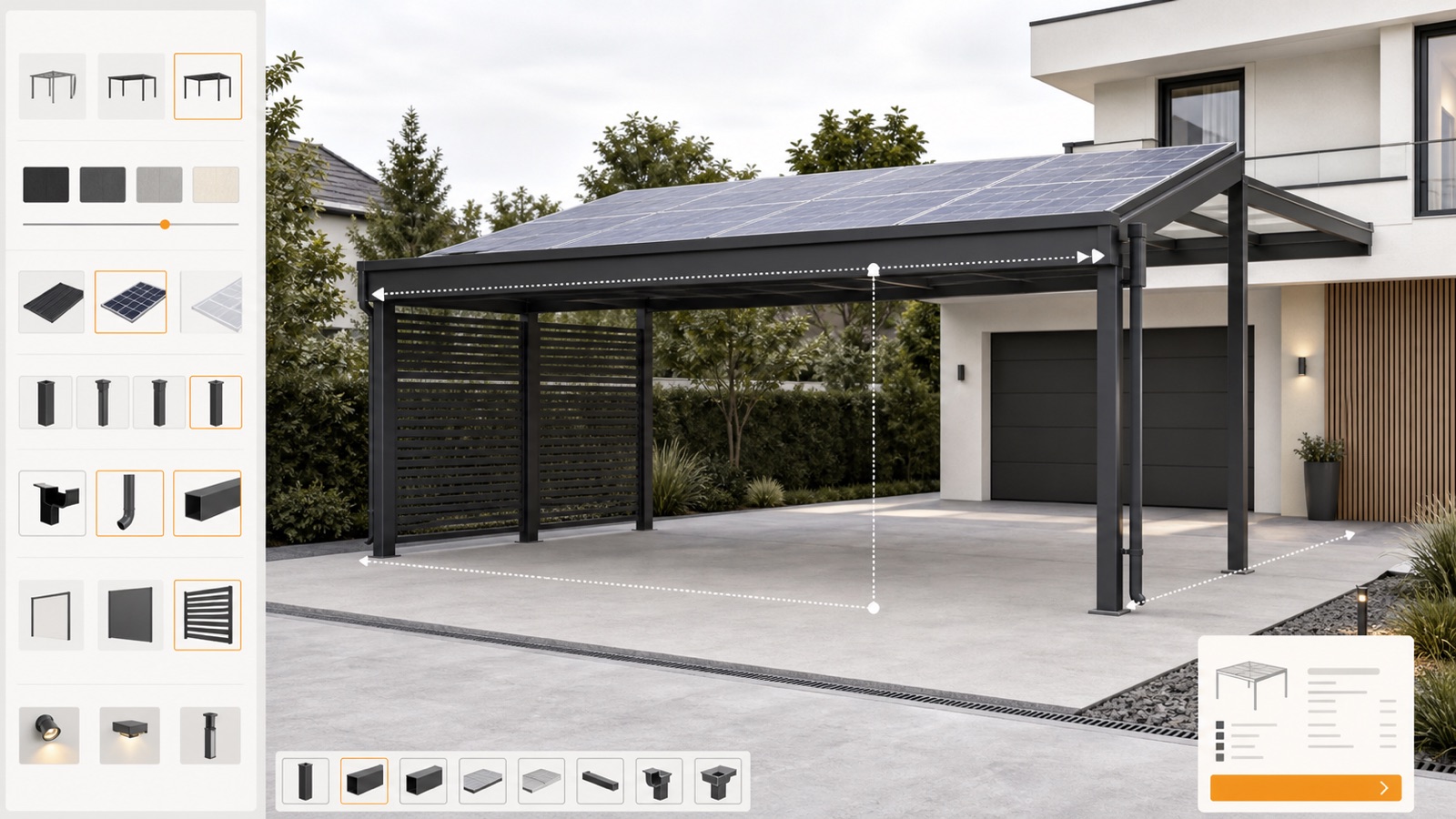
Table of contents
- What a carport configurator needs to understand
- Freestanding and wall-mounted layouts
- Single, double and multi-bay systems
- Roof systems
- Solar carports
- Posts and foundations
- Side panels, storage and accessories
- Live pricing for made-to-measure carports
- Bill of materials and project handoff
- What the buyer sees
- Better lead qualification for carport businesses
- Dealer and multi-market requirements
- Carport configurator evaluation checklist
- Configurix carport configurator
- Frequently asked questions
- Can a carport configurator include solar panels?
- Can the software handle double and multi-bay carports?
- Can we price installation by region?
- Can the configurator be embedded on our website?
Carport configurator software helps a customer, dealer or salesperson design a valid carport and receive a price or quote from the same project. The user selects the layout, dimensions, roof, posts, finish and accessories while the software applies product rules behind the scenes.
For made-to-measure aluminum, steel, timber or solar carports, the important value is not only the image. It is the connection between the visual design, the commercial calculation and the specification your team must deliver.
What a carport configurator needs to understand
Freestanding and wall-mounted layouts
The configuration starts with the structural type. Freestanding carports use posts on both sides. Wall-mounted systems may use a wall plate or beam connection. The choice affects dimensions, supports, foundations, drainage and installation.
Single, double and multi-bay systems
Vehicle count is a useful starting question, but the configurator should work with actual spans, projections and bay logic. Multi-bay systems may add intermediate posts, beams, roof zones and drainage points.
Roof systems
Common options include solid panels, polycarbonate, glass, standing seam, fabric and photovoltaic modules. Each roof can have its own pitch, span, support and drainage requirements.
Solar carports
A solar roof introduces module layout, electrical zones, inverter planning, cable routes and site-specific engineering. A configurator can make the option visible and collect structured project data, but energy yield, electrical design and structural approval should only be promised when those calculations are actually included.
Posts and foundations
Post positions must follow the chosen system and leave suitable vehicle access. Foundation type, anchors, ground conditions and local engineering can change the project. The configurator can apply standard rules and route exceptions for technical review.
Side panels, storage and accessories
Privacy screens, windbreaks, EV charging preparation, lighting, gutters, downpipes and storage modules can be added as compatible options. The system should block choices that collide or require an unavailable structural condition.
Live pricing for made-to-measure carports
Carport price can depend on width, projection, bays, roof area, profiles, posts, finish, roof material, solar option, accessories, foundations, delivery and installation.
A controlled CPQ calculation can combine:
- dimension or area formulas;
- standard size bands;
- structural and roof option prices;
- post and foundation quantities;
- accessory and package pricing;
- dealer margins and discounts;
- installation or delivery zones;
- tax, currency and market rules.
When the configuration changes, the visible estimate and quote should recalculate from the same rule set. Sales teams should not have to copy dimensions back into a spreadsheet after the customer has already made a decision.
Bill of materials and project handoff
A structured carport configuration can contain the information needed to produce a material list: beams, posts, roof components, connectors, drainage and selected accessories. More advanced projects may require cut data, drawings or external engineering results.
Define the boundary clearly. A configurator can create production-ready output only when every relevant rule, component and calculation is included and verified. Otherwise it should create a complete sales specification for technical approval.
Configurix can connect 3D configuration, pricing, BOM and ERP or CRM integrations inside a scoped white-label implementation.
What the buyer sees
A strong customer experience avoids technical overload. The buyer can:
- choose the carport type and number of bays;
- set dimensions within valid limits;
- compare roof and solar options;
- choose frame colour and side panels;
- add lighting, charging preparation or drainage options;
- view the carport in a clear 3D environment;
- see a price, budget range or request a quote;
- save the project and share contact or site details.
The salesperson can then open the same project with additional commercial or technical controls.
Better lead qualification for carport businesses
A carport configurator creates more useful enquiry data than a generic contact form. The project can arrive with:
- selected structural and roof system;
- width, projection and bay count;
- finish and accessories;
- solar interest and EV charging preparation;
- project location and installation preference;
- current estimate or configuration value;
- saved design image and project link.
That context helps the sales team prioritize and prepare for the first conversation. It also lets marketing measure which products and options generate real enquiries.
Dealer and multi-market requirements
Manufacturers selling through dealers may need one central catalogue with local price levels, taxes, currencies, languages and branded documents. A dealer portal can keep technical rules consistent while giving each partner the correct commercial experience.
Ask how permissions and changes are managed. A new roof component or price update should not require rebuilding every dealer’s configurator independently.
Carport configurator evaluation checklist
- Can the software handle freestanding, wall-mounted and multi-bay systems?
- Do dimension limits and post positions follow real structural rules?
- Can roof, solar, drainage and side options be linked by compatibility?
- Does live pricing match approved example calculations?
- Can site-specific exceptions be flagged for review?
- Can the saved design generate a branded quote and project record?
- Can BOM or order output be verified against known jobs?
- Can the system serve customers, salespeople and dealers?
- Is it fast and usable on mobile devices?
- Can products, prices and languages be maintained after launch?
Configurix carport configurator
The Configurix Carport Configurator is designed for carport manufacturers, distributors, dealers, retailers and installers selling configurable systems. It can combine white-label 3D visualization, product rules, made-to-measure dimensions, live pricing, branded proposals and structured project handoff.
A focused first product can usually launch through the Configurix Fast Launch program in around seven days. Larger white-label catalogues with several carport systems and integrations can be scoped up to 30 days.
Book a carport configurator demo to review your catalogue and see how one representative system can become a working sales flow.
Frequently asked questions
Can a carport configurator include solar panels?
Yes. It can visualize and price compatible solar roof options. Detailed electrical, yield or structural calculations must be explicitly included if they are required outputs.
Can the software handle double and multi-bay carports?
Yes, when the bay, span, support and roof rules of the catalogue are modelled.
Can we price installation by region?
Yes. Regional labour, delivery, tax and dealer rules can be included in the pricing model.
Can the configurator be embedded on our website?
Yes. Configurix can deliver a white-label experience on your domain and connect submitted configurations to your sales workflow.
Ready to try Configurix?
See how the configurator, quoting and CRM work together for your business.
Book a demo →Related articles
Materialen & levertijden automatiseren met 3D/AR‑configurators
Hoe fabrikanten en dealers materialen, voorraad en levertijden rechtstreeks uit een real‑time 3D/AR‑configurator laten aansturen — van automatische BOM tot nauwkeurige levertijd en geplande installatie.
Meertalige offertes & lokale compliance uit één 3D-configurator
Hoe fabrikanten en netwerk‑dealers met één real‑time 3D/AR‑configurator meertalige, belasting‑ en vergunning‑conforme offertes genereren — inclusief merk‑PDF, digitale handtekening en automatische planning.
Checklist: AR‑foto's, privacy en e‑handtekeningen voor pergola's
Praktische juridische en privacy-checklist voor monteurs en verkopers: AR‑foto's, klantfoto's, digitale handtekeningen en databeheer voor pergola‑projecten. Concrete actiepunten en implementatiestappen.